In a nutshell…
Safety Data Sheets are a capital document of chemical compliance, but correctly crafting them is more complex than it may seem.
Many companies face compliance issues, product delays, or even legal risks and quantizes fines due to errors in SDS authoring
Here we will discuss the 5 most common mistakes found in SDSs and how to avoid them!
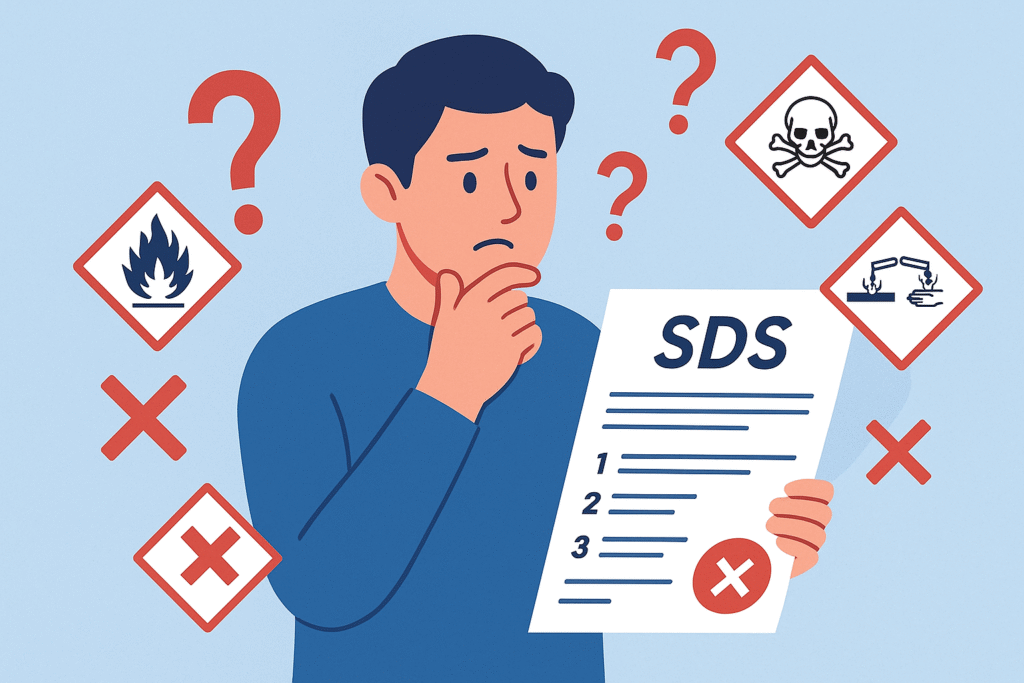
1. Incorrect or incomplete substance classification
This error is more present on SDSs of multicomponent mixtures ( fragrances, detergents, cosmetics, etc.). The culprits can be varied, but the most frequent arise from misinterpretations of CLP/GHS classification criteria, or using an outdated reference.
Why this matters?
An incorrect classification leads to wrong hazard statements and labelling, putting your company at legal and regulatory risk
How to avoid this?
Always use the latest harmonized classifications from official sources (Annex VI of CLP for EU or GHS relevant sources for other jurisdictions).
Pay special attention to document the methodology behind your classification decisions and track the regulatory updates.
2. Copy-paste SDSs
Re-using documents found on the internet, or supplier SDSs without adapting the content to current regulatory framework.
Why this matters?
Regulations are not universal. A random SDS found on the Internet might or might not be adapted to the adequate regulatory framework for your product. Besides, regulations change frequently (eg. REACH updates, CLP ATPs), so outdated content can make you copy-pasted SDS non-compliant
How to avoid this?
Do not copy SDS without checking the correct regulatory framework.
Double-check if the content is updated by consulting last releases of the official regulatory databases. In addition, ensure your SDS templates or authoring software is updated.
3. Missing or poorly produced Exposure Scenarios
Failing to include required exposure scenarios under REACH, or providing generic, vague descriptions not adapted to your jurisdiction constitutes a regulatory risk.
Why this matters?
The authorities expect exposure scenarios to be substance-specific and linked to the Chemical Safety Report (CSR). Missing details can invalidate your SDS.
How to avoid this?
Ensure that your SDS include exposure scenarios and that they are tailored to the actual uses and jurisdictions. Format them according to ECHA templates.
4. Not adapting to local language and format requirements
Sending the same SDS to multiple countries without proper translation or adaptation of the content to local regulations.
Why this matters?
An SDS must be provided in the official language(s) of the country where the product is placed. Non-compliant SDSs, such as English-redacted SDS for all EU market, can block sales.
How to avoid this?
Use professional translation services experienced in chemical terminology.
5. Inaccurate or incomplete data on section 9-16
Providing vague or placeholder data (eg. “not applicable”) in critical sections such as physico-chemical properties, stability or disposal considerations.
Why this matters?
These sections are essential for safely handling chemicals and emergency response . Missing or omitted data can expose your company to legal liabilities.
How to avoid it?
Gather accurate data from the literature when available or run reliable experiments to acquire it.
Follow ECHA guidance on the level of detail required in each section considering the potential risks of your products.
To summarize…
SDS authoring is not just a paperwork exercise, it’s a crucial compliance task that protects your company, your workers and your customers.
By avoiding those 5 mistakes in SDS authoring, you can have a great head start to assure that your SDSs meet the latest CLP, REACH, and GHS requirements.
Pro tip: if you are unsure about SDS compliance, protect your business working with an expert regulatory consultant who can ensure that your SDSs are fully compliant and adapted to each target market.
Do you need help? Check our SDS-ready services including a express option for a fully compliant SDS in only 48h!